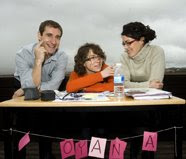
Ania Bas haciendo disonancias en Labein Tecnalia

diario del proceso artístico-colaborativo de Ania en Labein Tecnalia.

jueves 10 de julio de 2008

“Change the world”: Book Review


Why did i choose this book?

It’s the second book suggested by the TAE I read. It was in fact the book i wanted to read first. I was struck by the courageous simplicity of the title. Change the world, no more, no less. Of course, start changing yourself. I think it’s a biographical issue. I’ve gone through so many changes in life. Often I refer to my daily basis as swifting from a world into a different one. I have problems to connect the family realm with the job’s activities and relations. The same happens with the African friends and memories, with the group from architecture, who is not similar to the tasks at work, with the “hobby” at dance and theatre, with the Christian commitment, with Germany as a second reference. Changing from frame to frame, like a movie where personal roles are frame specific and often disconnected. The only connexion is always me. And since long, my personal mission of bridging worlds, of setting links between people and activities, of leaving behind a track, of networking task forces.

This is a book addressed to one’s personal change levers and motivations. It is hard on one’s pitfalls and barriers. It’s bold about one’s hypocrisy and misidentification of personal limits. It’s also an exercise book, not just to read, think about it and leave it behind. At least I feel compelled to implement what I’m reading. It can be a self-transformational book.


what is this book about?

It speaks about changing persons. About human growth and transformation both through life’s external changes which have an influence on the subjectivity and internal changes through maturity and commitment to life, which are put into behaviours, relations and actions. It explains a system for first changing oneself and then the surrounding world. It’s called the “advanced change theory”, ACT, a “set of action principles for more effectively introducing change to human systems”.

It speaks about freedom to become one’s highest self-image, and be accountable for it. It brings mature individuals into productive communities where members share a common purpose and work for the benefit of all. It reflects on the nature of hierarchy in order to introduce emergent adhocracy where groups become organisms and the leader is not a ruthless hero but an autothelic ordinary person able to flow with the reality and the persons around.


It starts by looking within oneself and making a fundamental choice for the life’s purpose which has found me. A choice which makes you true to yourself and opens a path of coherence where all you see is part of one large picture. Hypocrisy has then no room and the natural emergence of reality is not blocked by our former lack of integrity, ineffective behaviour, view on persons as things and purposelessness.

Many dilemmas are addressed, like the common good versus personal interest, solved by following the path of collective fulfilment being inner-directed and other-focused, moving on the edge of chaos from cycle to cycle. The dilemma of natural resistance to change is then seen as a feedback loop in which the change agent and the resisting system are joined in creative tension, nearer to reality than ever.


what have i learned?

This book has put together concepts which were separated for me. It serves as a guide through dilemmas in which i find myself deeply involved. This is all compressed into the task of becoming more autothelic, finding the courage to leave behind the script told by outside forces, disciplined by the 4 steps of “appreciative inquiry” (discovery, dream, design and destiny).

If I had any barrier to change and letting go, this books was heard in terms of faithfulness to my own process of unfolding. The core vision is not defined by personal survival, but by belonging to a productive community. Leadership is not fixed by position, but by spontaneous contribution. The state system is not under static equilibrium but under bounded instability. Social movements do not prevent insurgency but enact it. Empowerment is, beyond responsive, self-authorizing. Consciousness is not script driven anymore, but mindful and free. Moral reasoning does not answer to social expectations but to committed universal principles. Sanctions are not responded but transcended. The self is not divided but authentic. Communication of the self does not use symbols but turns oneself into a living symbol. Visions are not imitated and instructed but created and reframed.

All in all I think my sum up is forgetting the question “what do I have to lose?” and allowing myself to flow with reality. Another important point was brought by the “sacred servants” (Ghandi, M.L. King and Jesus of Nazareth), whose actions are used to illustrate the basic teachings of the book. Odd as they can be for today’s iconography, they where my hidden heroes, now to be brought to the front.


how will i implement what i've learned?

It’s not about doing things, it’s about being and becoming. There are a couple of beliefs I must check and transform into acts. I surrender to being a change agent for the growth of the world.

domingo 6 de julio de 2008

DisAniaLia @ Ptqk_blogzine


From Ptqk_blogzine: (read the full article)


Hoy quería dedicarle este post al trabajo de
Ania Bas con Labein-Tecnalia, uno de los más densos en ideas y posibilidades. Tecnalia es una corporación de centros de investigación vascos, de los que van en serio. Trabajan en el sector aeroespacial, de automoción, energia, infotech, medio ambiente urbano e industrial, etc. El concepto a investigar era la creación de un “entorno urbano sostenible” (SUE en inglés o sea, al revés). No está muy claro cómo se relaciona esto con las propuestas de Ania pero me imagino que tiene que ver con trabajar desde lo pequeño: los gestos cotidianos en el trabajo; la manera de estar y de pensarse en un entorno; ver qué se puede conseguir cuando se empiezan a introducir cambios desde el nivel de lo micro.

viernes 4 de julio de 2008

red de disonancias - video

para hacerse una idea de cómo lo visualiza el programa:


video

red de disonancias

Con un montón de ayuda he conseguido hacer una primera versión, bastante completa, de las personas y actividades que han participado de una u otra manera en disanialia, el proyecto disonancias de tecnalia con ania bas.

una imagen:


lo he hecho con the brain, y el original desde el programa es más interesante que la versión html que he enlazado desde el título -please click on the title to link to the html-.

también he colgado un pequeño video para que os hagáis una idea del original.

necesitais tener java instalado en el ordenador y activado desde el navegador de internet que estéis usando-java needs to be installed-.

os pido que comentéis errores (gente que falta en actividades...), olvidos, y sugerencias. desde el programa se pueden cargar objetos a las lineas y nodos, a lo mejor habrá una próxima versión más completa.

gracias

lunes 30 de junio de 2008

DisAniaLia & La Q


Collaboration? Check it out!

Ways of thinking


Q-tools: An approach for discovery and knowledge work

think.

PHRASES
have ( got) another think coming
informal used to express the speaker's disagreement with or unwillingness to do something suggested by someone else
think again
reconsider something, typically so as to alter one's intentions or ideas.
think out loud
express one's thoughts as soon as they occur.
think better of
decide not to do (something) after reconsideration.
think big
think fit
think for oneself
have an independent mind or attitude.
think nothing (or little) of consider
(an activity others regard as odd, wrong, or difficult) as straightforward or normal.
think nothing of it
do not apologize or feel bound to show gratitude (used as a polite response).
think on one's feet
react to events decisively, effectively, and without prior thought or planning
think twice
consider a course of action carefully before embarking on it.
think the world of
have a very high regard for (someone)

Ecofactory & Cover It Live


Alaitz from Ecofactory and Team Academy specially for the final presentation of results of DisAniaLia project agreed to Cover It Live for us. It did not work at the end but thanks a lot anyway Alaitz! Read the entry on Alaitz's web.

New Style... watch EiTB!


Gorka, thanks for sending the link!

martes 17 de junio de 2008

Trapped in the Lift (FILM)

lunes 16 de junio de 2008

A One-Day Challenge - after the conference

The conference was divided into two parts. The first part consisted of talks by 4 speakers who were introducing various subjects/views/ideas/policies. The second half was run using Open Space Technology (see blow) that was allowing people to share their views and discuss burning from individuals' point of view issues related to the subject of the conference. So it wasn't feeding delegates with the only truth about measuring not measurable. It was a platform to start dialogue about existing ways of measuring creativity and start conversation about other ways.

Open Space Technology and actually introduction to this working method is one of the most interesting things i have learnt during the day!

The final outcomes due to the nature of the working methods are not available on the day. When any gathered information arrives to me I will post it on the blog.

Quick intro to OST:
Open Space Technology (OST)enables groups of any size to address complex, important issues and achieve meaningful results quickly. It functions best where more traditional meeting formats fail: when there is conflict, complexity, diversity of thought or people, and short decision times. It has been used in widely diverse settings, from designing aircraft doors at a large aircraft manufacturing company to engaging street kids in defining a sustainable jobs program.
It is a new and powerful meeting methodology!

Four principles:
  • Whoever comes are the right people
  • Whatever happens is the only thing that could have
  • Whenever it starts is the right time
  • When it's over, it's over
Discussions take place in designated areas or separate rooms known as 'breakout spaces' and participants are free to move amongst the discussion groups. Each group records the conversations in a form which can be used to distribute or broadcast the proceedings of the meeting (in hard copy, blog, podcast, video, etc). In a multi-day Open Space, participants have the opportunity to announce new discussion topics / late-breaking sessions each new morning. At the end of the day (or 2 days or 2.5 days) the full group reconvenes for comments and reflection. This helps participants to re-engage in the full group over the duration of the meeting.

The "Law of Two Feet" — a foot of passion and a foot of responsibility — expresses the core idea of taking responsibility for what one loves. In practical terms, the law says that if you're neither contributing nor getting value where you are, use your two feet (or available form of mobility) and go somewhere where you can.

People can choose different roles for participation in Open Space meetings:

  • Host: the person who feels a burning passion for the subject and is willing to take responsibility to call the conversation, invite others in and make sure something gets harvested.
  • Participant: Anyone who is drawn to a conversation wants to stay the whole time and participate fully.
  • Bumble bee: The ones who move from conversation to conversation cross-pollinating the learning.
  • Butterfly: A butterfly may not want to be in any conversation, instead they prefer to sit on the lawn and look beautiful. A new, unexpected conversation may happen when two butterflies meet.
Open Space meetings make the assumption that people who care about the subject will come together. The initial meeting notice takes the form of an invitation, thus the people who have attended have chosen to be there and are willing to contribute. The objectives for the meeting and the time available affect design decisions such as whether action planning is included in the Open Space or not. More info about this method is available on line.